Data Center Technical Due Diligence (TDD): The 6-Pillar Site Audit & Red-Flag Checklist
Direct Answer Block: Data center technical due diligence (TDD) is an independent engineering assessment performed on behalf of institutional lenders or infrastructure buyers to evaluate the physical, electrical, mechanical, and civil risks of an operating or newly completed facility. It reconciles contractual capacity claims against primary utility records, physical equipment inventories, and site hydrology to formulate binding Conditions Precedent (CP) and financial escrow holdbacks before loan syndication or commercial acquisition.
When an infrastructure fund or private equity syndicate underwrites hundreds of millions of dollars to acquire a data center campus, the investment memorandum always boasts "Tier III concurrent maintainability," "dual diverse utility feeds," and "high-density AI readiness."
The Independent Engineer's job is not to echo the marketing deck. The Independent Engineer's job is to walk the physical plant, inspect the unpaved utility trenches, pull a fuel thief sample from the bottom of bulk diesel tanks, and verify whether the facility will survive when the grid collapses tonight.
1. The Four-Stage TDD Lifecycle & Risk Taxonomy
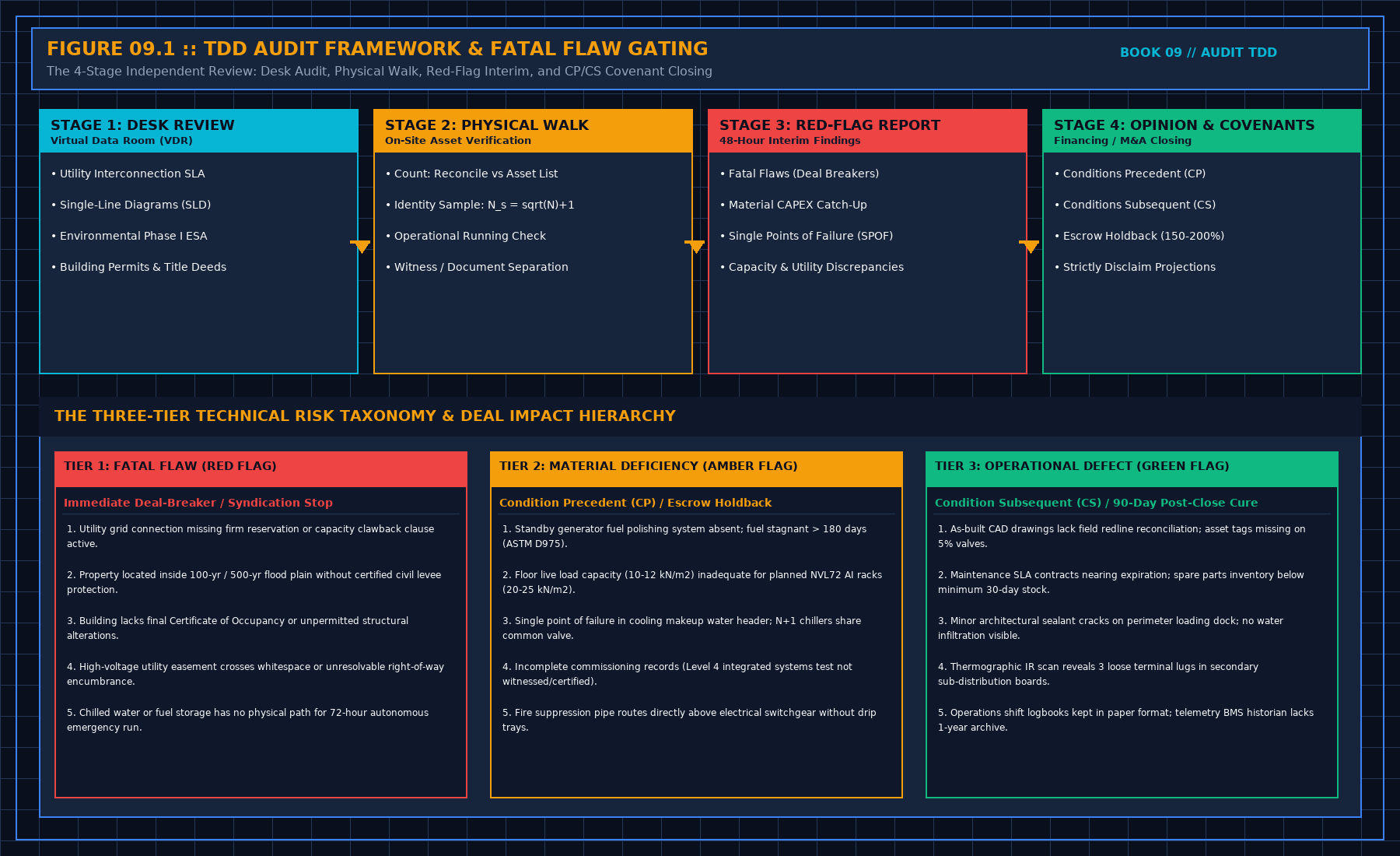
A professional technical due diligence audit proceeds through four disciplined operational stages:
- Stage 1: Virtual Data Room (VDR) Desk Audit: Prior to setting foot on site, audit primary documents: firm utility interconnection agreements, as-built Single-Line Diagrams (SLD), Phase I Environmental Site Assessments (ESA), Certificate of Occupancy, and integrated commissioning reports.
- Stage 2: Physical Site Walk and Asset Reconciliation: Execute the four core physical acts: Count total assets against the inventory ledger, Identify a sample using pre-written sampling rules (Nsample = √N + 1), Inspect running operational states (documenting what was dark), and Distinguish witnessed tests from accepted contractor certificates.
- Stage 3: 48-Hour Interim Red-Flag Memorandum: Deliver an early findings memorandum identifying fatal deal-breakers or material capital expenditure (CAPEX) catch-up items before legal teams finalize loan documents.
- Stage 4: Final Technical Opinion & Financing Covenants: Draft enforceable Conditions Precedent (CP) required prior to loan drawdown, Conditions Subsequent (CS) post-closing cure items, and calculated escrow holdbacks.
The Three-Tier Risk Hierarchy
- Tier 1: Fatal Flaws (Red Flag): Unmitigated 100-year or 500-year flood zone exposure, lack of uncurtailable firm utility reservation, unpermitted building expansions, or structural floor load deficits that preclude promised compute density. Halts debt syndication immediately.
- Tier 2: Material Deficiencies (Amber Flag): Degraded standby fuel, single points of failure in cooling makeup water, or missing Level 4 integrated systems testing. Solved via mandatory Conditions Precedent (CP) or a 150%–200% financial escrow holdback of the estimated remediation cost.
- Tier 3: Operational Defects (Green Flag): Backlogged CAD as-built redlines, minor maintenance contract renewal gaps, or cosmetic non-structural concrete spalling. Cured under Conditions Subsequent (CS) within a 60- to 90-day post-closing window.
2. Utility Substation Diversity: The Single-Bus Illusion
Developers frequently present two separate utility power account numbers as proof of grid redundancy. In reality, both feeds often share a single point of failure:
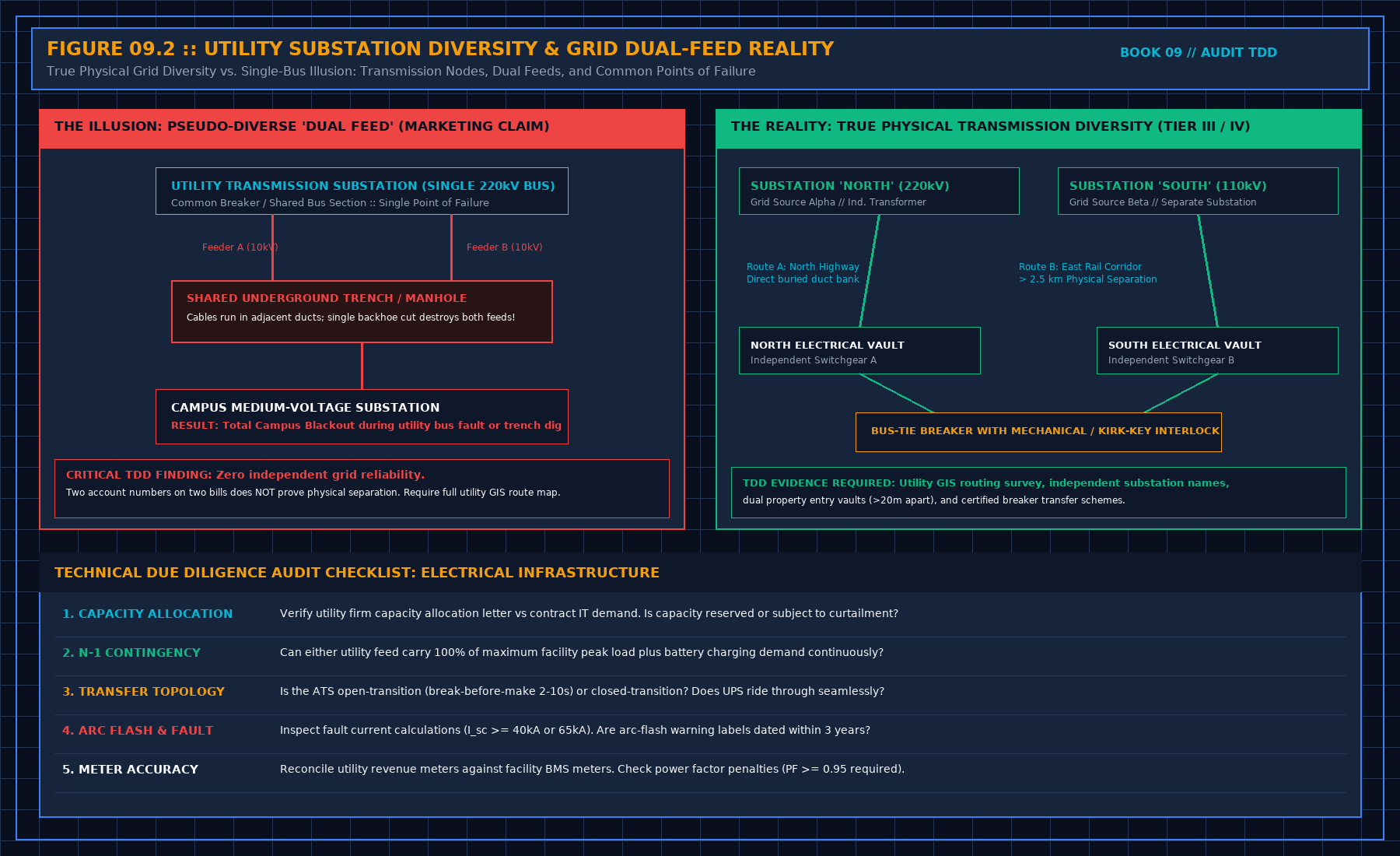
The Pseudo-Diverse Trap
As illustrated in Figure 2, developers often pull two medium-voltage cables (10 kV) from the exact same primary utility transmission substation busbar. Even worse, both cables are frequently routed through the same shared trench or street manhole outside the property boundary.
A single municipal excavator strike or manhole fire cuts both circuits simultaneously, plunging the entire data center into a total blackout.
The True Physical Diversity Standard
Under institutional underwriting guidelines (IEEE Std 141 and GB 50174 Class A), true transmission grid diversity mandates:
- Independent Transmission Substations: Feeder A and Feeder B must originate from two separate transmission substations (e.g., Substation Alpha at 220 kV and Substation Beta at 110 kV) fed by distinct high-voltage grid segments.
- Geographical Separation: The two feeder routes must maintain at least 1.5–2.5 km of physical separation, traversing different public rights-of-way with zero shared utility bridges or duct banks.
- Dual Entry Vaults: Underground feeders must enter the campus through independent concrete-encased duct banks on opposite sides of the property, terminating in separate electrical vaults located at least 20 m apart.
3. Civil Hydrology: The 500-Year Flood Plain Mandate
While commercial office buildings rely on the 100-year flood plain (1.0% annual exceedance probability), mission-critical data center financing demands adherence to the 500-Year Base Flood Elevation (0.2% annual exceedance probability):
- Finished Floor Level (FFL): All critical IT whitespaces, UPS rooms, and electrical switchgear rooms must be elevated at least +1.0 m to +1.5 m above the certified 500-year BFE.
- Stormwater Retention (Rational Method): On-site retention basins must retain a 100-year, 24-hour storm event without city storm sewer reliance:
$$Q = C \times I \times A$$
Where Q is peak runoff (m³/s), C is runoff coefficient (0.90 for paved data center roofs/yards), I is rainfall intensity (mm/hr), and A is catchment area (m²).
- Hydrostatic Uplift: Basements located below historical groundwater levels must have dual-membrane waterproofing and emergency generator-backed sump dewatering pumps.
4. Standby Fuel Autonomy & Fuel Quality Physics
A facility cannot claim Tier III or Tier IV concurrently maintainable autonomy without an auditable, unshared on-site fuel reserve providing at least 72 hours of continuous full-load generation:
$$V_{\text{fuel}} = N_{\text{gen}} \times \dot{m}_{\text{fuel}} \times t_{\text{run}} \times 1.15$$
For a 20 MW IT load supported by 10 standby diesel generators (2.5 MVA each, burning 540 L/h at 100% load):
$$V_{\text{fuel}} = 10 \times 540\,\text{L/h} \times 72\,\text{h} \times 1.15 \approx 447,120\,\text{liters} \quad (\approx 448\,\text{m}^3)$$
The Stagnant Diesel Threat (ASTM D975 / D2709)
Ultra-Low Sulfur Diesel (ULSD) stored in underground tanks degrades within 6 to 12 months. Moisture condensation creates an anaerobic environment where bacteria metabolize hydrocarbons, producing acidic asphaltic sludge.
When generators start during a grid outage, this bottom sludge is drawn into high-pressure common rail (HPCR) injectors operating at 2,000 bar, seizing them in under 15 minutes.
TDD Field Action:
- Verify an automated duplex fuel polishing system that cycles 100% of tank volume every 30 to 45 days, with coalescing water separation (< 50 ppm per ASTM D2709) and 2-micron particulate filtration.
- Pull a bottom thief sample. If cloudy or dark, mandate a Condition Precedent for laboratory fuel assay and chemical remediation.
5. Structural Floor Loading for NVL72 AI Racks
Liquid-cooled AI superclusters impose extreme mechanical stresses that legacy enterprise data centers cannot bear:
| Facility Class | Uniformly Distributed Load (UDL) | Concentrated Caster Load (Ppoint) | AI Compatibility |
|---|---|---|---|
| Legacy Enterprise | 5.0–8.0 kN/m² (500–800 kg/m²) | ≤ 2.5 kN | Incompatible |
| Hyperscale Cloud | 10.0–12.0 kN/m² (1,000–1,200 kg/m²) | ≤ 3.5 kN | Standard CPU only |
| AI Supercluster (NVL72) | 18.0–25.0 kN/m² (1,800–2,500 kg/m²) | ≥ 4.5 kN per caster | Mandatory for NVL72 |
An NVL72 rack weighs up to 1,800 kg operational. Rolling this mass across raised access flooring produces dynamic point loads exceeding 6.5 kN.
- Raised access floor pedestals must be certified to ≥ 15.0 kN concentrated load (CISCA / MOB PSA) with stringer deflection ≤ L/360.
- In post-tensioned (PT) concrete slabs, any floor core-drilling for CDU liquid cooling headers requires certified Ground Penetrating Radar (GPR) scans to prevent severing structural tendons.
Frequently Asked Questions (FAQ)
What is the difference between a Data Center TDD and a Phase I ESA?
A Phase I Environmental Site Assessment (ESA, ASTM E1527) audits only hazardous materials, historical soil/groundwater contamination, and chemical liabilities. A Technical Due Diligence (TDD, ASTM E2018) evaluates the entire physical infrastructure: utility electrical diversity, mechanical chiller redundancy, structural floor load capacity, emergency fuel autonomy, and operational compliance.
How is a Condition Precedent (CP) enforced in data center financing?
A Condition Precedent is a mandatory legal covenant in the credit agreement that must be fully cured before lenders authorize initial debt drawdown. If a defect cannot be physically cured before closing, lenders enforce a financial escrow holdback—typically reserving 150%–200% of the engineer's estimated remediation cost in an escrow account released only after re-inspection sign-off.
Can an Independent Engineer certify facility capacity based on utility application letters?
No. A utility application or pending permit represents potential future capacity, not firm present capacity. The Independent Engineer must only certify capacity supported by fully executed, firm, uncurtailable utility allocation agreements and installed physical electrical switchgear.
The Book Bridge
A technical due diligence visit is where millions of dollars in financing terms are won or lost. The complete auditor's field guide—including the full 6-pillar visit sheet, sample size calculators, single-line reconciliation protocols, and the legal wording of technical refusal—is detailed in Walk a TDD: Technical Due Diligence Physical Site Audit by Tristan.
Walk a TDD ($12.99) — Coming Soon on Amazon Kindle & EPUB
Master the Complete Protocol: Walk a TDD: Technical Due Diligence Physical Site Audit
Substation Transmission Diversity, 500-Year Flood Hydrology, NVL72 Floor Loads, and Fatal Flaw Gating
Stop relying on contractor spreadsheets and vendor promises. This field guide provides the complete, auditable verification binder—including acceptance thresholds, physical equations, inspection checklists, and signed refusal templates.